Nepal Budget 2082/83 introduces significant policy, legal, and regulatory reforms that will shape the country’s business and industrial landscape. As the Government of Nepal prioritizes economic growth, private sector participation, foreign investment, and industrial development, businesses must understand the legal implications arising from the budget announcements. This article examines the key provisions of the Budget 2082 83 Nepal, highlights the compliance obligations they may trigger, and outlines the practical steps businesses should consider to remain compliant and capitalize on opportunities created by the Budget for Nepal.
1. Background and Strategic Importance of Nepal Budget
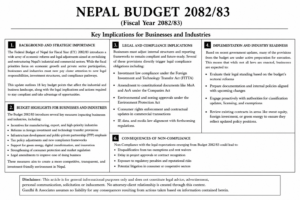
The Nepal Budget for Fiscal Year (F.Y.) 2082/83, also referred to as the Budget 2082 83 Nepal, introduces a wide array of economic reforms and legal adjustments aimed at revitalizing and restructuring Nepal’s industrial and commercial sectors. While the fiscal priorities focus on economic growth and private sector participation, businesses and industries must now pay closer attention to new legal responsibilities, investment structures, and compliance pathways.
This update outlines 18 key Nepal Budget points that affect the industrial and business landscape, along with the legal implications and actions required to stay compliant and take advantage of opportunities under the Budget for Nepal.
2. Nepal Budget Highlights for Businesses and Industries
The following table summarizes major provisions from the budget along with the sectors impacted and relevant compliance pointers:
| Provision | Impacted Sector | Compliance or Legal Concern |
| Foreign investment up to 25% of export income permitted | Export-oriented industries | NRB guidelines, investment structuring, foreign exchange control |
| Recognition of Sweat Equity Shares | Startups, IT, Tech | Amendment of AoA, share allotment compliance |
| Land ceiling relaxed for productive sectors | Agriculture, Housing, Industrial | Land Use Act compliance, documentation, cooperative land structuring |
| Legal reform in digital, IP, telecom sectors | IT, OTT platforms, broadcasting | Anticipated new legislation, IP registration, content compliance |
| Criminal penalties for cooperative mismanagement | Cooperatives, Financial sectors | Internal audits, forensic assessments, potential litigation support |
| Nationwide expansion of consumer courts | FMCG, Retail, E-commerce | Consumer rights compliance, dispute representation readiness |
| Zoning and EIA to proceed simultaneously | Infrastructure, Hydropower, Real Estate | Integrated licensing, environmental law compliance |
| AI centers, data centers, and cybersecurity policy in pipeline | Tech, Data Economy | Data governance frameworks, AI legal risk assessment |
| Tax exemptions for green and EV sectors | Energy, Manufacturing, Import | Customs and Excise Act compliance, environmental certifications |
| 75% tax exemption on IT export income | IT, BPO, Software Export | Tax audit preparedness, export documentation integrity |
| Budget for PPP projects in transport, hydro, airport | Infrastructure, Construction | PDA contract reviews, concession negotiation, FDI structuring |
| Unified higher education law | Education, Private Colleges | Structural alignment, regulatory filings for academic institutions |
| Youth employment incentives and loans | Startups, SMEs | HR compliance, loan documentation, MoU with banks |
| Restructuring and mergers of cooperatives | Cooperative Societies | Due diligence, merger contracts, liquidation guidance |
| OTT platform regulation proposed | Media, Streaming, Digital | Licensing frameworks, broadcast code adherence |
| Hotels and resorts classified as productive sector | Tourism, Hospitality | Tax rebate applications, business classification adjustments |
| Rent waiver and relocation support for SEZ based industries | Manufacturing, Export Units | SEZ guidelines, lease agreements, relocation planning |
| Bioethanol, fuel blending, and green hydrogen projects supported | Energy, Agri-tech | Environmental licensing, feasibility reports, tax benefits |
3. Legal and Compliance Implications for Nepal Budget
Businesses must adjust internal structures and reporting frameworks to remain compliant and future-ready following the Nepal Budget 2082/83. Several of these provisions directly trigger legal compliance obligations including:
- Investment law compliance under the Foreign Investment and Technology Transfer Act (FITTA)
- Amendment to constitutional documents like MoA and AoA under the Companies Act
- Environmental and zoning approvals under the Environment Protection Act
- Consumer rights enforcement and contractual updates in commercial transactions
- IP, data, and media law alignment with forthcoming regulations.
4.Implementation and Industry Readiness
Based on recent government updates, many of the provisions from the Budget 2082 83 Nepal are under active preparation for execution. This means that while not all laws are enacted, businesses are expected to:
- Evaluate their legal standing based on the Budget for Nepal sectoral reforms
- Prepare documentation and internal policies aligned with upcoming changes
- Engage proactively with authorities for classification updates, licensing, and exemptions
- Review existing contracts in areas like sweat equity, foreign investment, or green energy to ensure they reflect updated policy positions.
5. Immediate Action Points for Businesses
Businesses and industrial enterprises should consider taking the following actions in light of Budget 2082/83:
| Action Point | Purpose |
| Conduct legal assistance in light of budget reforms | Identify compliance gaps, missed exemptions |
| Update MoA, AoA or Shareholder Agreements | Reflect sweat equity and sector-specific benefits |
| Consult on SEZ relocation or reclassification | Utilize rental waiver and subsidy support |
| Review investment and foreign funding plans | Align with NRB and IBN guidelines for 25% foreign investment |
| Prepare for EIA or project clearance integration | Expedite infrastructure project execution |
| Seek early registration for emerging sectors | Hydrogen, biofuel, AI, and OTT to gain first-mover advantage |
Note: This shall apply as applicable.
6. Consequences of Non-Compliance
Non-Compliance with the legal expectations emerging from the Nepal Budget 2082/83 could lead to:
- Disqualification from tax exemptions and rent waivers
- Delay in project approvals or contract recognition
- Exposure to regulatory penalties and reputational risks
- Potential litigation in consumer or cooperative sectors
Related Resources
Explore More from Gandhi & Associates
Businesses affected by the Nepal Budget 2082/83 should also consider reviewing other legal areas that commonly arise during implementation of budget reforms, including:
- Foreign Investment and Technology Transfer Act (FITTA) compliance
- Company registration and corporate restructuring in Nepal
- Commercial contract drafting and legal review
- Corporate and commercial legal advisory services
- Environmental and regulatory compliance
- Intellectual Property (IP) protection in Nepal
- Tax and investment law advisory
Visit: https://www.lawgandhi.com
Official Government Resources
For the latest official notifications and implementation guidelines relating to the Budget 2082 83 Nepal, businesses may refer to:
Conclusion
The Nepal Budget 2082/83 represents more than an annual fiscal announcement—it signals important legal and regulatory developments that will influence how businesses operate, invest, and remain compliant in Nepal. While several measures require legislative implementation, businesses should begin assessing their legal position, reviewing internal governance documents, and preparing for sector-specific regulatory changes. Taking timely legal advice and proactively aligning with the evolving framework can help organizations minimize compliance risks while taking advantage of new opportunities introduced by the Budget for Nepal.
Frequently Asked Questions (FAQs)
1. What is the Nepal Budget 2082/83?
The Nepal Budget 2082/83 is the annual fiscal budget presented by the Government of Nepal for Fiscal Year 2082/83. It outlines government spending, taxation, investment policies, industrial reforms, and legal measures affecting businesses and individuals.
2. How does the Nepal Budget 2082/83 affect businesses?
The budget introduces reforms relating to foreign investment, industrial classification, consumer protection, environmental compliance, taxation, corporate governance, and regulatory approvals that businesses should carefully review.
3. Do businesses need to make immediate legal changes after the Budget 2082/83 Nepal?
Some budget announcements require future legislative amendments before becoming legally enforceable. However, businesses should begin reviewing their corporate documents, contracts, compliance policies, and licensing requirements to prepare for upcoming changes.
4. Which laws are most relevant to the Nepal Budget 2082/83?
Key laws include:
- Foreign Investment and Technology Transfer Act (FITTA)
- Companies Act
- Environment Protection Act
- Consumer Protection Act
- Industrial Enterprises Act
- Income Tax Act
depending on the nature of the business.
5. Can businesses claim budget incentives automatically?
No. Most incentives, exemptions, or benefits announced in the budget are subject to eligibility criteria, implementing regulations, and compliance requirements prescribed by the relevant government authorities.
6. Why should businesses seek legal advice after the Nepal Budget?
Legal professionals can help businesses interpret newly announced measures, assess compliance obligations, update corporate documentation, review contracts, and minimize regulatory risks as implementation progresses.