Immediate Social Welfare Council relief measures, working through local partners, and establishing a longer-term INGO presence in Nepal
Why this matters. The recent floods affecting Rasuwa, Nuwakot, Dhading and other districts have prompted the Social Welfare Council (“SWC”) to issue emergency notices encouraging national and international non-governmental organisations to support rescue, relief and rehabilitation. For foreign humanitarian organisations, the practical issue is how to move quickly without treating an emergency arrangement as a substitute for the regulatory structure required for a sustained presence in Nepal.
Key takeaways - The SWC’s 26 and 29 August 2026 notices create a temporary facilitation framework for flood-response activities, including a notice-based 48-hour expedited approval mechanism for qualifying disaster-response programmes.
- For an organisation without an approved Nepal presence, the most workable emergency structure will often be to normally operate through an appropriate Nepalese partner and coordinate with the relevant local government and District/Local Disaster Management Committees.
- The emergency measures are not a blanket exemption from SWC approval. The Social Welfare Act contains narrow exceptions, and retrospective regularisation should not be assumed to be automatically available in every case.
- An organisation that intends to remain in Nepal should consider the longer-term INGO pathway: General Agreement (GA), office and registrations, local implementing partner, Project Proposal/local consensus and Project Agreement (PA).
- In practice, a GA commonly carries a minimum annual programme commitment of USD 200,000, administrative-cost controls, reporting and audit obligations, and asset-disposal requirements at exit.
|
1. Current SWC Emergency Measures
The SWC’s first urgent notice, dated 26 August 2026 (2083/05/10), called on national and international non-governmental social organisations to assist with immediate rescue, relief and rehabilitation. It directed organisations to coordinate with the relevant local level, District Disaster Management Committee and District Administration Office, and to provide information on their activities to the SWC.
The follow-up notice, dated 29 August 2026 (2083/05/13), introduced the more detailed temporary facilitation and expedited approval measures applicable to the declared disaster-affected areas through the end of Ashoj 2083. The notice is particularly important for organisations that already have an approved Nepal project or an existing local implementing partner.
What the 29 August 2026 notice facilitates
- Use of existing approved disaster-management budgets, subject to notice to the SWC and relevant authorities and alignment with identified relief needs.
- Specified reallocations or amendments within approved projects so that resources can be redirected to relief activities, subject to the limits stated in the notice.
- Work in declared disaster-affected localities through an INGO’s existing Nepalese partner even where those localities fall outside the INGO’s ordinary approved project area, after informing the SWC.
- Flexibility, where the SWC considers it necessary, on ordinary administrative/programmatic and hardware/software budget ratios for new disaster-response projects.
- SWC recommendations to the relevant customs office for import permission for essential relief materials intended for declared disaster-affected areas.
- Implementation in coordination with the Local Disaster Management Committee and District Disaster Management Committee, with the SWC stating that such disaster-response programmes will be approved within 48 hours through the expedited process.
- Mandatory progress reporting to the SWC in the prescribed format.
- A dedicated Rapid Response Team and facilitation services even on public holidays during the emergency period.
Important: expedited approval is not the same as no approval The 29 August 2026 notice expressly provides an accelerated approval route including approval of qualifying disaster-response programmes within 48 hours. It should not be read as a general authorisation for every foreign organisation to remit and deploy unrestricted funds first and seek approval later. Where activities have already commenced because of genuine emergency conditions, the organisation should notify the SWC immediately and regularise the position without delay, but the legal basis and approval route should be confirmed for the organisation and project concerned. |
2. Legal Framework for Foreign Humanitarian Organisations
Social Welfare Act, 2049 (1992)
Section 12 requires a foreign non-governmental organisation wishing to work in Nepal to apply to the SWC for permission before commencing work. The SWC may decide on the application within a maximum of three months, and an organisation that receives permission must enter into an agreement with the SWC before operating in Nepal.
Section 16 governs the receipt of financial, technical, material and other assistance for social-welfare projects. As a general rule, a social organisation seeking such assistance must submit the relevant project proposal and details to the SWC. The section also requires approved projects to be implemented with the cooperation and coordination of the relevant local level, and foreign financial assistance for an approved project to be made through commercial banks operating in Nepal.
Section 16 contains two limited emergency-related exceptions that should be read carefully:
- For a programme that must be completed immediately, assistance of up to NPR 200,000 per year may be received after prior information to the SWC, with a report to be submitted within three months after completion.
- An organisation established under an international convention to which Nepal is a party need not obtain prior SWC approval for assistance received for emergency rescue services, but must inform the SWC after receiving the assistance.
These statutory exceptions are narrow. The second exception, in particular, does not automatically apply to an ordinary foreign charity or INGO merely because it is undertaking humanitarian work. For most organisations responding to the present floods, the current SWC emergency notice and its rapid-approval process provide the safer operational route.
Disaster Risk Reduction and Management Act, 2074 (2017)
Nepal’s disaster-management legislation establishes the District Disaster Management Committee (DDMC) and Local Disaster Management Committee (LDMC) as core response bodies. Among other functions, the DDMC coordinates rescue, relief and recovery at district level and may direct government and non-governmental offices to distribute relief according to approved standards. The LDMC is responsible for local disaster-management planning and for coordinating government, private, non-governmental, volunteer and community actors.
Practical implication. An aid organisation should not treat local-authority coordination as a formality. It is part of the legal and operational architecture for rescue and relief, and is also expressly reinforced by the SWC’s current flood notices.
3. Immediate Relief: A Practical Route for Foreign Organisations
Step 1 – Identify the Nepal-side implementing structure
Where the foreign organisation does not yet have its own approved Nepal presence, the most workable emergency structure will often be an established Nepalese NGO or other qualified local partner with the capacity to receive funds, procure or distribute relief, maintain records and coordinate with the authorities.
The partner arrangement should be documented. At minimum, the parties should clearly record the relief activities, budget, source and flow of funds, procurement responsibility, asset ownership, reporting, safeguarding/compliance obligations and responsibility for SWC and local-government coordination.
Step 2 – Coordinate before distribution
Before deploying relief in an affected locality, the Nepal-side implementing team should engage with the relevant local government/LDMC and, where applicable, the DDMC and District Administration Office. This helps confirm current needs, avoid duplication, align distribution with government priorities and establish an auditable record of coordination.
Step 3 – Notify the SWC and use the rapid-response process
The 29 August 2026 notice provides the clearest express mechanism for new disaster-response programmes: coordinated humanitarian, rescue and rehabilitation programmes in the declared disaster-affected areas are to be approved by the SWC within 48 hours through the expedited process contemplated by the notice. The SWC has also created a Rapid Response Team to facilitate project approval, agreements and related services.
For organisations already operating under approved projects, the first question is whether the existing project and budget can be used or amended under the temporary measures. For organisations without an existing Nepal approval, the appropriate Nepal-side applicant and approval path should be confirmed promptly rather than assuming that the emergency itself removes the approval requirement.
Step 4 – Import relief goods carefully
The 29 August 2026 notice states that the SWC may recommend to the relevant customs office that import permission be provided for essential materials required for distribution in declared disaster-affected areas. This facilitation does not displace sector-specific requirements. Medicines, medical devices, food, communications equipment and other regulated goods may require separate approvals from the competent Nepalese authority.
Step 5 – Maintain records and report
Emergency speed should not come at the expense of documentation. Organisations should maintain partner agreements, bank records, invoices, procurement records, stock registers, beneficiary/distribution records, local coordination correspondence and any import documentation from the outset.
The 29 August 2026 notice makes progress reporting to the SWC mandatory in the format prescribed by the Council. Where any activity commenced before formal approval was completed, the organisation should disclose the facts and regularise the position promptly rather than treating retrospective approval as automatic.
4. Immediate Response and Longer-Term Presence Should Run on Separate Tracks
Immediate emergency response | Longer-term INGO presence |
Local partner + local/DDMC coordination | GA + Nepal office/tax/banking/staffing |
SWC notification/ expedited 48-hour rapid approval where applicable; relief delivery through the approved Nepal-side structure; records and prescribed reporting | Local partner selection; Project Proposal/local pre-consensus; PA; approved funding/implementation; reporting, audit and monitoring |
At a glance: two-track response pathway
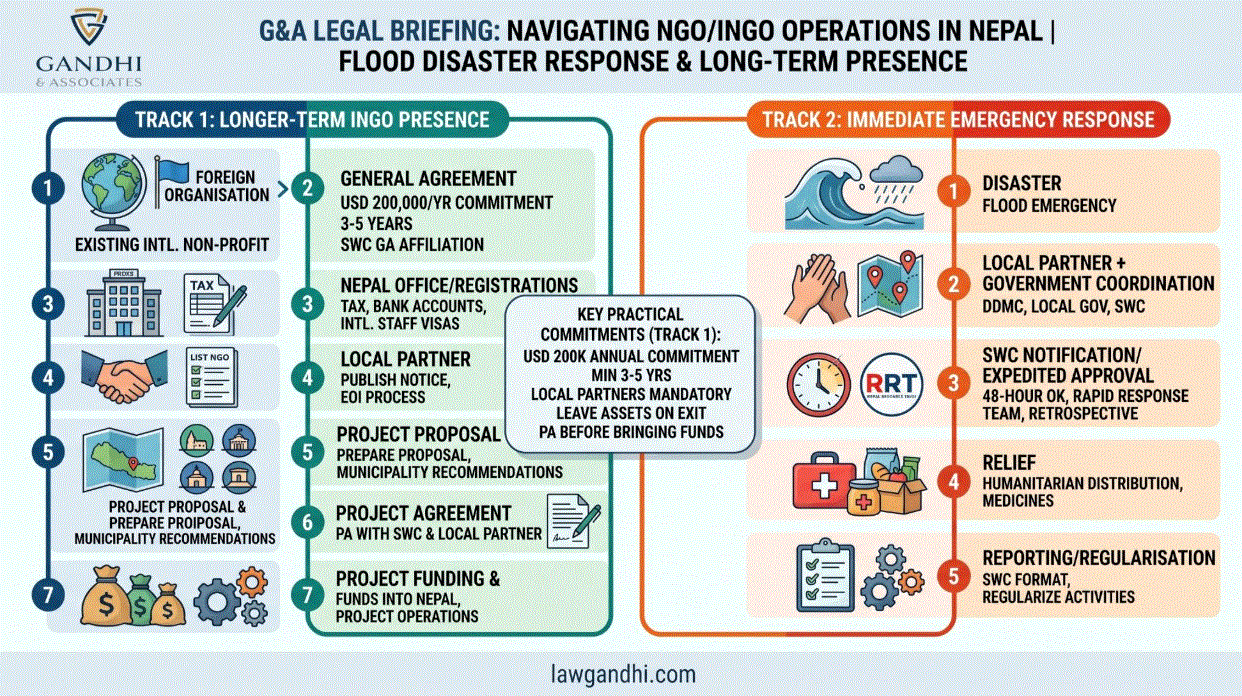
Figure 1. G&A overview of the immediate emergency-response and longer-term INGO pathways. The infographic is a practical summary; the detailed legal qualifications in this briefing prevail where the route depends on the organisation’s status, existing approvals or project circumstances.
5. Establishing a Longer-Term INGO Presence
A foreign organisation that expects to maintain personnel, an office or continuing programmes after the emergency should not rely indefinitely on an ad hoc relief arrangement. The usual longer-term route is to obtain SWC permission and enter into a General Agreement, followed by project-specific approval through a Project Agreement.
5.1 General Agreement (GA)
The GA is the umbrella agreement governing the INGO’s institutional presence in Nepal. The Social Welfare Act provides the statutory basis for the permission and agreement requirement; the detailed operational obligations are contained in the SWC’s standard-form GA and related guidelines.
- Term: in practice, GAs are commonly structured for approximately three to five years.
- Financial commitment: the standard framework generally requires a minimum commitment of USD 200,000 per year for Nepal programmes, excluding commodity assistance.
- Project proposal: the standard GA commonly requires the INGO to submit its project proposal within three months of signing the GA; an additional period may be considered by the SWC on a reasoned request.
- Administrative cost: current SWC practice requires administrative/overhead expenditure to remain below 20% of the total project budget, subject to any specific approved exception.
- Implementation: the INGO works through Nepalese implementing partner NGO(s), and funds committed for implementation are to be provided to the partner in accordance with the approved project structure.
- Coordination: projects should be designed and implemented in coordination with the relevant provincial/local authorities and should obtain the required local pre-consensus documentation.
- Reporting and audit: the framework includes periodic activity reporting, annual reporting and annual audited accounts.
5.2 Nepal office, banking, staffing and foreign personnel
After the GA and the necessary post-affiliation formalities, an INGO can ordinarily establish its Nepal office, obtain tax/PAN registration, seek SWC recommendations for bank accounts and employ Nepalese staff.
The standard GA framework also permits the SWC to facilitate or recommend non-tourist visa arrangements for an approved foreign country representative and their immediate family, and work authorisation for approved expatriate personnel. These are facilitation mechanisms rather than an automatic entitlement: the individual, role, project and immigration/work-permit requirements must still be satisfied.
5.3 Local implementing partner selection
INGO projects are ordinarily implemented through qualified Nepalese partner NGOs. Partner selection should be transparent, documented and defensible. Depending on the project and SWC requirements, this may involve a public notice or Expression of Interest process. Organisations should allow time for due diligence on the prospective partner’s registration, SWC affiliation, tax status, governance, audit history, programme capability and geographic fit.
5.4 Project Proposal and local pre-consensus
The INGO must then develop a detailed Project Proposal covering the objectives, beneficiaries, geography, activities, implementation arrangements, results framework and budget. The SWC’s current PA materials require local pre-consensus documentation from the relevant municipality/rural municipality and include prescribed formats for the PA, logical framework, budget, public notice and amendment process.
5.5 Project Agreement (PA)
The PA is the substantive approval for the particular project and is entered into with the SWC and the implementing partner(s). The current SWC PA format requires the INGO and NGO to identify central and project bank accounts, with SWC recommendation required for account opening. It also regulates import privileges, project duration, amendment, termination and asset treatment.
Normal sequencing matters. Outside the special emergency framework, an INGO should plan on finalising the PA before ordinary project implementation and before attempting to deploy project funds. As a practical banking matter, Nepalese banks may ask for evidence of the relevant SWC project approval before releasing or allowing use of foreign project funds.
6. Key Commitments Foreign Organisations Should Plan For
Minimum annual programme commitment
The USD 200,000 annual commitment can be significant for an organisation whose involvement in Nepal began with a short emergency response. Before commencing GA affiliation, the organisation should confirm that its programme pipeline and funding model can support the commitment throughout the contemplated GA term.
Administrative-cost ceiling
The standard SWC framework limits administrative/overhead costs to less than 20% of the total project budget. The current flood notice allows the SWC to exercise flexibility on ordinary ratios for new disaster-response projects where necessary, but organisations should not assume that emergency flexibility will carry into ordinary long-term programming.
Foreign staff and immigration
A foreign organisation that needs a continuing expatriate management presence should address the GA/PA pathway early. Long-term work should not be undertaken on tourist status, and visa/work-permit facilitation is tied to the approved INGO and project framework.
Assets at project closure or exit
Current SWC project-agreement terms provide that, on termination, withdrawal, completion or closure, project assets – including assets imported or purchased under duty-free privileges – become the property of the SWC or another organisation as determined by the Government of Nepal. Major capital procurement should therefore be planned with the exit/transfer position in mind from the outset.
Reporting, audit and monitoring
Longer-term INGO operations involve continuing compliance. The SWC’s monitoring framework expects periodic progress and financial reporting, annual audit, local-government coordination, project monitoring/evaluation and appropriate asset/inventory controls. Compliance should be built into the project’s finance and programme systems rather than treated as an end-of-project exercise.
7. Recommended Roadmap for an Organisation Entering Nepal during the Flood Response
Stage | Priority actions |
Immediate 24-72 hours | Confirm the Nepalese partner and written emergency arrangement; identify affected localities; coordinate with local government/LDMC and DDMC; notify the SWC; determine whether existing project authority applies or a rapid approval is required. |
First week | Complete the applicable rapid SWC approval process; regularise any activity already commenced; confirm import/sector approvals; establish project-level banking and record-keeping; preserve complete procurement and distribution records. |
Relief phase | Implement against identified needs; maintain government coordination; submit SWC progress/reporting; monitor whether the planned Nepal involvement will extend beyond the emergency. |
If staying longer | Start the GA process in parallel; prepare organisational documents, governance information and programme commitment; plan office, tax, banking, staffing and immigration requirements. |
After GA | Select/due-diligence local partner(s); prepare Project Proposal and local pre-consensus; execute PA before normal project implementation/funding; implement continuing reporting, audit and monitoring systems. |
8. G&A Experience in Disaster-Response and INGO Matters
Gandhi & Associates’ Development and Non-Profit Practice has longstanding experience advising international organisations on SWC approvals, establishment, labour and employment, taxation, immigration, contracts and regulatory compliance. During the humanitarian response following Nepal’s 2015 earthquakes, the firm assisted foreign organisations in establishing and regularising their presence in Nepal and in structuring implementation through local partners.
That experience remains relevant to the present flood response: the legal strategy should distinguish between the structure needed to deliver urgent assistance now and the institutional framework required if the organisation intends to remain after the emergency.
9. Practical Checklist
- Is the organisation responding only to the current emergency, or does it expect a continuing Nepal programme?
- Does it already have an SWC-approved project or an existing Nepalese partner?
- What is the proposed flow of funds, and what SWC approval or bank documentation will be needed?
- Which local government/LDMC and DDMC must be consulted before distribution?
- Are any medicines, medical devices, food, telecommunications equipment or other regulated goods being imported?
- Have the partner agreement, procurement rules, safeguarding obligations and record-keeping responsibilities been documented?
- Has the SWC been notified and, where required, has the 48-hour rapid-approval process been initiated?
- If the organisation plans to remain, can it support the GA financial commitment and the partner-based implementation model?
- Will foreign personnel require non-tourist visas and work permits?
- Has the organisation planned for PA approval, reporting, audit, monitoring and eventual asset transfer/disposal?
10. Conclusion
Nepal’s current flood-response arrangements are designed to make humanitarian action faster, but they do not remove the need to identify the correct legal route. For many foreign aid organisations, the immediate pathway will be to work through an appropriate Nepalese partner, coordinate closely with local and district disaster-management authorities, notify the SWC and use the applicable special rapid-approval and reporting arrangements.
Where the organisation intends to maintain an office, personnel or programmes in Nepal after the immediate response, it should begin the longer-term INGO process in parallel: General Agreement, Nepal registrations and office arrangements, local implementing partner selection, Project Proposal and local pre-consensus, and Project Agreement before ordinary project implementation and funding.
The central planning point is therefore not whether emergency response and INGO affiliation are alternatives. In many cases, they are two tracks that should proceed at the same time.
References / Further Reading
- Social Welfare Act, 2049 (1992), particularly sections 12 and 16
- Disaster Risk Reduction and Management Act, 2074 (2017), particularly sections 16 and 17
- Social Welfare Council – Guideline for PA Appraisal (the SWC webpage currently lists the Project Agreement Guideline, 2071, Fifth Amendment 2081, and current annexes/forms)
- Social Welfare Council – Monitoring & Evaluation Guideline and reporting formats
- Social Welfare Council urgent notice dated 26 August 2026 (2083/05/10) concerning rescue, relief and rehabilitation following the floods.
- Social Welfare Council notice dated 29 August 2026 (2083/05/13) concerning facilitation of NGO/INGO flood-response projects, reporting and the Rapid Response Team.
Source currency: This briefing reflects the legal and SWC materials reviewed as of 2 September 2026.
Disclaimer: This article is for general informational purposes only and does not constitute legal advice, advertisement, personal communication, solicitation or inducement. No attorney-client relationship is created through this content. Gandhi & Associates assumes no liability for any consequences resulting from actions taken based on information contained herein. |