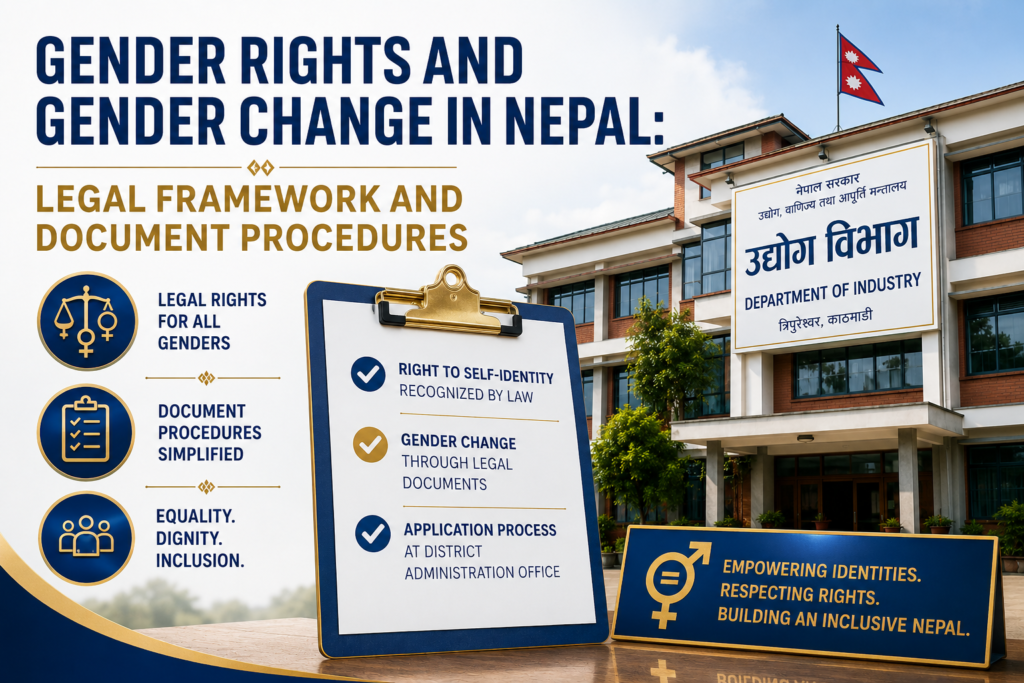
 Gender rights in Nepal include legal recognition of gender identity and procedures for updating gender markers on official documents.
The ability to update gender markers in official legal documents is a fundamental aspect of the right to self-identification and human dignity. In Nepal, this right is recognized under constitutional guarantees and supported by key judicial precedents, most notably Sunil Babu Pant V. Government of Nepal (2064) (2007). Despite this legal recognition, administrative procedures remain opaque, inconsistent, and heavily reliant on informal practices.
This briefing outlines the legal framework, document-specific procedures, and practical challenges associated with updating gender markers in Nepal.
What Is the Legal Framework for Gender Rights in Nepal?
- Constitutional and Judicial Basis
The right to update one’s gender marker is grounded in several legal instruments and precedents, which include:
- Constitution of Nepal (2015):
- Article 12: Right to citizenship based on gender identity;
- Article 18: Right to equality;
- Article 42: Right to social justice.
- Supporting Case Law
- Sunil Babu Pant V. Government of Nepal (2064) (2007): The Supreme Court of Nepal mandated recognition of non-binary identities and provision of corresponding legal documentation;
- Dilu Dibuja v. Ministry of Foreign Affairs (2017): Established the right to a passport reflecting one’s updated gender identity.
Which Legal Documents Allow Gender Marker Updates in Nepal?
The documents where gender marker changes are permitted (in practice or law) include:
- Birth Certificate;
- Citizenship Certificate;
- Passport;
- National Identity Card (NID);
- Voter ID;
- Academic Transcripts and Certificates;
- Driver’s License.
How Does Gender Change in Nepal Work Across Official Documents?
While the legal framework in Nepal does not provide a single uniform procedure for updating gender markers, in practice, individuals may apply for amendments across various official documents. The table below sets out the key documents where gender marker updates are permitted, the procedural steps typically required, and important notes on challenges or inconsistencies in implementation.
|
Document
|
Procedure
|
Notes
|
|
Birth Certificate
|
Apply at ward office with:
a) Application for amendment;
b) Updated legal ID;
c) Affidavit or court order (sometimes required).
|
–
|
|
Citizenship Certificate (Primary Document)
|
Apply at District Administration Office (DAO) with:
a) Original citizenship certificate;
b) Self-declaration/affidavit of gender identity;
c) Recommendation letter from recognized LGBTQ+ organization (e.g., Blue Diamond Society);
d) Proof of residence;
e) Parents’ citizenship certificates (if requested).
If accepted, DAO issues a new certificate listing “O” as gender marker.
|
• Most DAOs do not permit binary-to-binary changes (e.g., M→F);
• Some DAOs may ask for medical certificates or deny applications arbitrarily;
• Procedures vary due to lack of clear administrative code.
|
|
Passport
|
Apply to Department of Passport with:
a) Updated citizenship certificate;
b) Passport application form with “O” marked as gender;
c) Passport photos & applicable fees.
|
• Updated citizenship certificate is mandatory;
• If denied, decision can be legally challenged.
|
|
National Identity Card (NID)
|
Apply through ward-level center with:
a) Updated citizenship certificate;
b) Completed NID form.
|
• NID auto-syncs gender from citizenship;
• Errors may occur in digital system if citizenship not updated first.
|
|
Voter ID
|
Apply at District Election Office with:
a) Updated citizenship certificate;
b) Voter ID amendment request form/application letter.
|
• No clear directive; implementation inconsistent;
• Some offices deny requests arbitrarily;
• May require escalation to Election Commission.
|
|
Academic Transcripts & Certificates
|
Apply through institution registrar with:
a) Updated citizenship or passport;
b) Affidavit/explanatory letter;
c) Court affidavit or notarized deed poll (in some cases).
|
• Policies vary by institution;
• Tribhuvan University often requires notarization.
|
|
Driver’s License
|
Apply to Department of Transport Management with:
a) Updated citizenship certificate;
b) Existing driving license;
c) Correction request form.
|
• Some offices unlawfully ask for medical certificate or affidavit.
|
Note: While the following procedures list typical documentation requirements, individual offices may request additional materials or impose informal conditions. Applicants are advised to prepare for such variations and retain copies of all submissions.
What Should Applicants Know About Gender Rights Applications?
- Always carry updated citizenship when applying for changes in secondary documents;
- Secure support letters from recognized LGBTQ+ organizations;
- Maintain documentation copies and receipts for all submissions.
Disclaimer: This article is for general informational purposes only and does not constitute legal advice, advertisement, personal communication, solicitation or inducement. No attorney-client relationship is created through this content. Gandhi & Associates assumes no liability for any consequences resulting from actions taken based on information contained herein.
Where Can You Learn More?
Related Resources from Gandhi & Associates
Official Government Resources
Conclusion For Gender Rights
Gender rights in Nepal include legal recognition of gender identity and related document updates. However, procedures can vary between authorities and documents. Applicants should verify current requirements with the relevant authority before applying.
FAQs
What are gender rights in Nepal?
Gender rights in Nepal include legal recognition of gender identity and the ability to update gender markers in official documents.
Which documents can have their gender marker updated in Nepal?
The listed documents include birth certificates, citizenship certificates, passports, NIDs, voter IDs, academic certificates, and driver’s licenses.
Is there one uniform procedure for gender change in Nepal?
No. The approved content states that Nepal does not have a single uniform procedure for updating gender markers.
What documents may be required to update a citizenship certificate?
The listed requirements include the original citizenship certificate, a self-declaration or affidavit, a recommendation letter, proof of residence, and parents’ citizenship certificates if requested.
What should applicants do when applying for document changes?
Applicants should carry updated citizenship, secure support letters where appropriate, and maintain copies and receipts of submissions.