FOREIGN TRADEMARK REGISTRATION IN NEPAL

Introduction

A trademark is a distinctive sign used to identify and distinguish the goods or services of one enterprise from those of others. Trademarks may consist of words, names, logos, symbols, labels, devices, images, slogans, or a combination of these elements.

Trademark protection is territorial in nature. Registration of a trademark in one country does not automatically confer protection in another jurisdiction. Consequently, foreign trademark owners seeking legal protection in Nepal must obtain trademark registration in Nepal in order to secure enforceable rights within the country.

Nepal follows a registration-based trademark protection system. Although certain remedies may be available under general legal principles, registration remains the primary mechanism through which trademark rights are recognized and enforced. Foreign businesses intending to manufacture, distribute, market, or sell goods and services in Nepal are therefore strongly advised to register their trademarks before entering the Nepalese market.

Trademark registration and protection in Nepal are governed principally by the Patent, Design and Trademark Act, 2022 (1965) (“PDTA”). The Act expressly permits the registration of foreign trademarks and provides the legal framework for registration, renewal, assignment, cancellation, and enforcement of trademark rights.

The Department of Industry (“DOI”), operating under the Ministry of Industry, Commerce and Supplies, is the government authority responsible for the administration of trademark matters in Nepal.

Legal Framework

National Legislation

Trademark registration and protection in Nepal are primarily governed by the following laws:

  • Patent, Design and Trademark Act, 2022 (1965) – The principal legislation governing trademark registration, publication, opposition, renewal, assignment, cancellation, and enforcement.
  • Nepal Treaty Act, 2047 (1990) – Provides for the implementation of Nepal’s international treaty obligations within the domestic legal framework.

International Treaties

Nepal is a party to several international instruments relating to intellectual property protection. Pursuant to Section 9 of the Nepal Treaty Act, the provisions of treaties ratified or acceded to by Nepal become enforceable as Nepalese law to the extent of any inconsistency with domestic legislation.

The principal international instruments relevant to trademark protection include:

  • Paris Convention for the Protection of Industrial Property (Member since 22 June 2001);
  • Agreement on Trade-Related Aspects of Intellectual Property Rights (TRIPS Agreement) (Member since 23 April 2004); and
  • Convention Establishing the World Intellectual Property Organization (WIPO Convention) (Member since 4 February 1997).

Although Nepal is a member of the World Intellectual Property Organization (WIPO), it is currently not a member of the Madrid Protocol. Accordingly, international trademark registrations under the Madrid System cannot be extended to Nepal, and trademark protection must be sought through a direct national filing before the Department of Industry.

Competent Authority

The Department of Industry (DOI) is the authority responsible for:

  • Receiving and processing trademark applications;
  • Examining trademark registrability;
  • Publishing accepted applications;
  • Administering opposition proceedings;
  • Registering and renewing trademarks;
  • Recording assignments and changes relating to registered trademarks; and
  • Adjudicating certain trademark-related disputes at the administrative level.

Eligibility for Registration of Foreign Trademarks

Foreign individuals, corporations, and other legal entities may apply for trademark registration in Nepal.

Traditionally, foreign trademark applications are filed on the basis of a valid trademark registration obtained in the applicant’s home jurisdiction. The Home Registration Certificate serves as the principal supporting document for registration in Nepal.

Priority Claims

Nepal recognizes priority rights under Section 21C of the PDTA and the Paris Convention.

An applicant who has filed a trademark application in another convention country may claim priority in Nepal, provided that the Nepalese application is filed within six (6) months from the date of the first filing. Where a valid priority claim is accepted, the Nepal application is deemed to have been filed on the priority date of the earlier foreign application.

Trademark Registration Procedure

The registration procedure for foreign trademarks is substantially similar to that applicable to domestic applicants.

StepProcedureDescription
1Filing of ApplicationApplication is filed before the DOI together with the prescribed documents and fees. Applications may be submitted in English.
2ExaminationThe DOI conducts formal and substantive examination to determine compliance with legal requirements and assess potential conflicts with existing trademarks.
3PublicationAccepted applications are published in the Industrial Property Bulletin.
4Opposition PeriodAny interested party may file an opposition within ninety (90) days from publication.
5RegistrationIn the absence of opposition, the trademark proceeds to registration and issuance of the registration certificate.
6Opposition ProceedingsIf an opposition is filed, the DOI hears the parties and issues a reasoned decision.
7AppealParties aggrieved by the DOI’s decision may appeal before the competent High Court and, where applicable, further challenge the decision before the Supreme Court.

Expected Timeline

The registration timeline may vary depending on the workload of the DOI and whether any opposition is filed.

  • Uncontested applications: approximately 6–10 months.
  • Contested applications: one year or longer depending upon the complexity of the proceedings and appeals.

Documents Required

The following documents are generally required for the registration of a foreign trademark in Nepal:

  1. Trademark application in the prescribed format;
  2. Notarized copy of the Home Registration Certificate;
  3. Four copies of the trademark representation or label (8 cm × 8 cm);
  4. Original Power of Attorney executed in favour of the local trademark agent or attorney;
  5. Board Resolution or equivalent authorization document (for corporate applicants).

Document Authentication

Documents issued outside Nepal should generally be notarized. Where documents are prepared in a language other than English, a certified English translation should also be submitted.

Grounds for Refusal

The DOI may refuse registration during examination or following opposition proceedings if the proposed trademark falls within any of the prohibited categories under the PDTA.

Common grounds for refusal include:

  • The trademark is identical or confusingly similar to an earlier registered trademark;
  • The trademark is deceptive, misleading, or likely to cause confusion among consumers;
  • The trademark is contrary to public morality, public order, or public interest;
  • The trademark adversely affects the reputation or prestige of an individual or institution;
  • The trademark contains national flags, state emblems, official insignia, or protected symbols without authorization;
  • The trademark is inconsistent with Nepalese law or Nepal’s international obligations.

Conducting a trademark availability search prior to filing is therefore advisable to minimize the risk of refusal or opposition.

Classification of Goods and Services

Although the PDTA authorizes the Government of Nepal to prescribe a classification system through notification in the Nepal Gazette, no separate national classification system has been formally adopted.

In practice, the Department of Industry follows the internationally recognized Nice Classification System, which consists of 45 classes:

  • Classes 1–34: Goods
  • Classes 35–45: Services

A separate trademark application and corresponding government fee must be filed for each class of goods or services.

Duration of Registration and Use Requirement

A trademark registration in Nepal remains valid for a period of seven (7) years from the date of registration.

Unlike many jurisdictions, Nepalese trademark law imposes a statutory use requirement. A registered trademark is expected to be brought into genuine commercial use within one year from the date of registration.

Where a trademark remains unused, the DOI may initiate an inquiry and may cancel the registration on grounds of non-use.

Trademark proprietors should therefore ensure that the registered mark is actually used in connection with the registered goods or services within Nepal after registration.

Renewal of Trademark Registration

Trademark registrations may be renewed indefinitely for successive periods of seven years.

To maintain continuous protection, the proprietor must:

  • File a renewal application; and
  • Pay the prescribed renewal fee within the statutory renewal period.

Where renewal is not completed within the prescribed timeframe, the law provides an additional grace period. Failure to renew within the permissible period may result in removal of the trademark from the register and loss of statutory protection.

Accordingly, trademark owners should maintain a robust trademark portfolio management system to monitor renewal deadlines.

Enforcement of Trademark Rights

Once registered, the proprietor acquires the exclusive right to use the trademark in relation to the registered goods or services within Nepal.

A registered proprietor may take legal action against unauthorized use, imitation, counterfeiting, or infringement of the trademark. Depending on the circumstances, remedies may include:

  • Administrative action before the Department of Industry;
  • Seizure of infringing goods by competent authorities;
  • Civil remedies and injunctions before the courts; and
  • Other relief available under applicable Nepalese laws.

Timely registration significantly strengthens the ability of trademark owners to prevent infringement and protect brand value in the Nepalese market.

Conclusion

Trademark registration is an essential step for foreign businesses seeking to establish or expand their presence in Nepal. Since trademark rights are territorial and Nepal is not currently a member of the Madrid Protocol, foreign trademark owners must obtain national registration in Nepal to secure effective legal protection.

Early registration not only safeguards brand identity but also facilitates enforcement against infringement, counterfeiting, and unauthorized use. Trademark owners should further ensure compliance with statutory use requirements, monitor potential infringements, and renew registrations in a timely manner to maintain uninterrupted protection.

Businesses considering market entry into Nepal are advised to seek professional legal assistance to navigate the registration process and develop an effective trademark protection strategy tailored to their commercial objectives.
Carbon Trading in Nepal: Legal Framework and Opportunities for Foreign Participation

Carbon trading is emerging as a critical mechanism for mitigating climate change globally, and Nepal is steadily developing a regulatory framework to facilitate participation by both domestic and foreign entities. This article provides an overview of the legal, procedural, and compliance requirements for foreign governments, institutions, and businesses interested in engaging in carbon trading activities in Nepal.

  1. Legal Basis for Carbon Trading

Nepal’s carbon trading market is primarily governed by the Environment Protection Act, 2076 (2019) and the Carbon Trading Regulations, 2082 (2025). These laws establish the legal foundation for the development, approval, registration, implementation, monitoring, and transfer of carbon credits generated from greenhouse gas emission reduction and climate-mitigation projects.

The Government of Nepal, through the Ministry of Forests and Environment and other sectoral authorities, serves as the primary regulator for carbon trading activities. Foreign participation is recognized under these regulations, provided it complies with Nepal’s environmental policies and regulatory requirements.

  1. Pathways for Foreign Participation

Nepalese law allows foreign entities to participate in carbon trading through three main pathways:

  1. Government-to-Government or Bilateral Mechanisms

Under this pathway, the Government of Nepal may enter into bilateral agreements with foreign governments or institutions to facilitate carbon trading. Agreements at this level may allow participation by commercial or institutional entities of both countries. Benefit-sharing and transaction frameworks are determined by the terms of the bilateral agreement. This mechanism is particularly suitable for strategic or policy-level carbon-credit collaborations.


  1. Project-Based Participation through a “Proponent”

A “Proponent” is an entity that develops a carbon-trading project. Eligible proponents include Nepal-registered companies, joint ventures between foreign and Nepalese companies, and government entities at federal, provincial, or local levels. Foreign companies cannot directly operate project-level carbon trading but may either establish a Nepal-registered company or form a joint venture with a Nepalese company. Proponents are responsible for obtaining approvals, registering carbon credits in the National Carbon Registry, and entering agreements with buyers.


  1. Carbon Trading via the Government of Nepal

Carbon credits generated from approved projects and registered in the National Carbon Registry may also be transferred through the Government of Nepal. In this case, the government acts as an intermediary in the transaction, ensuring regulatory oversight and compliance.

Nepal recognizes two main carbon-credit mechanisms: the Paris Agreement Carbon Credit Mechanism, for projects aligned with international frameworks, and the Voluntary Carbon Market Mechanism, which includes projects approved by the Ministry, whether private, government-owned, or community-based.


  1. Developing, Approving, and Registering Projects

The procedural framework for carbon trading projects in Nepal is structured as follows:

  1. Project Concept Note

Proponents submit a Project Concept Note to the relevant ministry. Forest-related projects are submitted to the REDD Implementation Centre, while other projects are submitted to the appropriate sectoral ministry. Ministries provide recommendations for the proponent to prepare the full Project Document.


  1. Project Document Preparation

The Project Document must be prepared within one year of receiving approval for the Concept Note. Extensions of up to one additional year may be granted upon justification. The Carbon Trading Management Committee evaluates the document to ensure alignment with Nepal’s carbon-reduction commitments, environmental and social impacts, and Sustainable Development Goals (SDGs).


  1. Approval and Registration

After evaluation, the Ministry issues a formal Approval Letter. Fees are based on project size, ranging from NPR 25,000 for micro projects to NPR 100,000 for large-scale projects. Following approval, projects intending to trade carbon credits under the Paris Agreement must register with the relevant international mechanism. The Ministry provides a Project Registration Number, which serves as the official identifier for all carbon trading transactions. Approved projects are valid for an initial period of five years and may be renewed up to a total of fifteen years.


  1. Compliance, Reporting, and Administrative Requirements

Proponents must comply with structured standards covering project implementation, measurement, reporting, verification, registry registration, and profit-sharing, as provided below:

  1. Project Implementation: Upon approval of the Project Document, the proponent must commence project implementation within one (1) year and notify the Ministry accordingly.

  2. Agreements: The proponent must enter into contracts with local communities, institutions, or buyers, including certified copies submitted to the Ministry.

  3. Measurement, Reporting, Verification (MRV): Measurement and reporting are the responsibility of the proponent, while certification must be conducted by an independent, accredited third party recognized under the relevant mechanisms. Certified reports must be submitted to the Designated National Authority, and carbon credits issued through such certification will be counted in the National Carbon Registry.

  4. National Carbon Registry: All credits must be recorded in the registry maintained by the Ministry of Forests and Environment.

  5. Nationally Determined Contribution (NDC): Five percent of verified credits contribute to Nepal’s NDC.

  6. Fees and Profit Sharing: A carbon credit sale fee of NPR 100 per ton applies to the volume of carbon credits available for sale after deducting the NDC portion. Further, carbon credit sale fees and mandatory government profit-sharing apply (10% for private projects).

  7. Annual Reporting: Reports submitted within three months of the fiscal year-end to the Designated National Authority; and consolidated reports sent to the UNFCCC every two years.

  8. International Treaty Compliance: All activities must comply with relevant international agreements. Projects must commence within one year of approval, with possible extensions. Agreements with beneficiaries and buyers must be executed, with certified copies submitted to the Ministry.


  1. Foreign Investment and Profit Repatriation

Foreign entities may participate as proponents through Nepal-registered companies or joint ventures. Profits proportional to foreign investment may be legally repatriated, subject to compliance with the Foreign Investment and Technology Transfer Act, 2075 (2019). Standard corporate taxation and administrative obligations apply to all projects.

  1. Eligible Sectors for Carbon Trading

Nepal encourages projects that provide environmental and social benefits across six sectors:

  1. Renewable Energy Development Sector

  2. Energy Efficiency and Clean Energy Transition Sector

  3. Agriculture, Forestry, and Other Land-Use Sector

  4. Waste Management Sector

  5. Transport Sector

  6. Adaptive and Resilience Co-Benefit Sector

  1. Conclusion

Nepal provides a structured legal and regulatory framework for carbon trading, offering foreign investors the opportunity to contribute to climate mitigation while participating in a growing carbon market. For project-level carbon trading, forming a joint venture or establishing a Nepal-registered company is typically the most practical approach, while government-to-government arrangements allow for broader strategic collaboration.

Engaging in Nepal’s carbon trading market enables foreign participants to support national and international climate goals, drive sustainable development, and access emerging opportunities in carbon markets.

Disclaimer: This article is for general informational purposes only and does not constitute legal advice, advertisement, personal communication, solicitation or inducement. No attorney-client relationship is created through this content. Gandhi & Associates assumes no liability for any consequences resulting from actions taken based on information contained herein.

For quick legal assistance:

Phone/Viber/WhatsApp: +977 9709035477

For specific legal advice regarding carbon trading in Nepal, please contact our office to schedule a consultation with our experts.


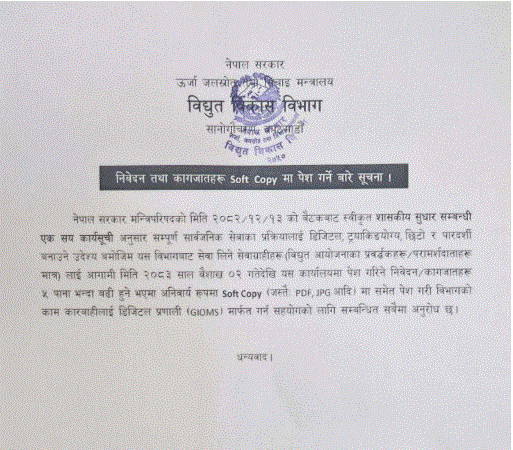
Department of Electricity Development Mandates Soft Copy Submission of Applications and Documents from 2083/01/02 (15 April 2026)

Promoters and consultants of electricity projects must submit soft copies (PDF, JPG, or similar) of all applications and documents exceeding five pages when filing with the Department of Electricity Development, effective from 2083/01/02 (15 April 2026).

  1. Introduction

The Department of Electricity Development (DoED), under the Ministry of Energy, Water Resources and Irrigation, has issued a notice requiring promoters and consultants of electricity projects to submit soft copies of applications and documents exceeding five pages alongside physical submissions, effective from 2083/01/02 (15 April 2026).

The requirement stems from the 100-point governance reform agenda approved by the Council of Ministers on 2082/12/13 (27 March 2026), aimed at making public service processes digital, trackable, fast, and transparent through the Government Integrated Office Management System (GIOMS).

  1. Key Highlights

  1. Effective 2083/01/02 (15 April 2026), all applications and documents exceeding five pages must be submitted to the DoED in soft copy format (PDF, JPG, or similar) alongside physical copies.

  2. This requirement applies exclusively to promoters and consultants of electricity projects.

  3. Documents of five pages or fewer are not subject to this requirement.

  4. Submissions will be processed through the GIOMS platform.


  1. Practical Implications

  1. Soft Copy Submission Requirement

Promoters and consultants must ensure that any application or document exceeding five pages is submitted in both physical and digital formats from the effective date. Non-compliance may result in processing delays or requests for resubmission.

  1. Transition to GIOMS

All departmental work will be processed through GIOMS. Promoters and consultants are advised to familiarise themselves with the platform ahead of the effective date to ensure seamless submission.


Snapshot of Notice

Department of Electricity Development Mandates Soft Copy Submission of Applications and Documents from 2083/01/02 (15 April 2026)

This article is for general informational purposes only and does not constitute legal advice, advertisement, personal communication, solicitation or inducement. No attorney-client relationship is created through this content. Gandhi & Associates assumes no liability for any consequences resulting from actions taken based on information contained herein.

For quick legal assistance

Phone/Viber/WhatsApp: +977 9709035477

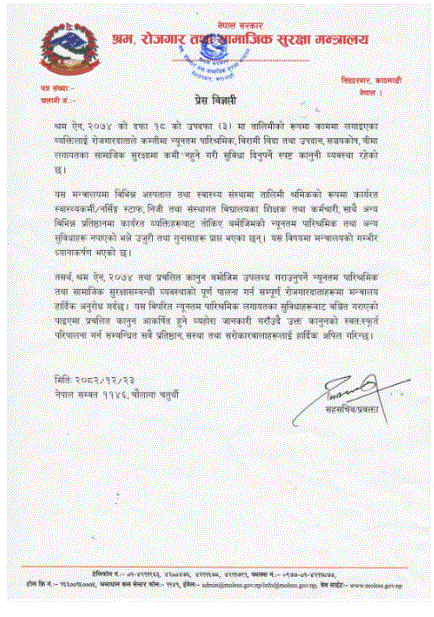
Ministry of Labour Warns Employers on Minimum Wage and Social Security Obligations for Trainee Workers

Employers engaging trainee workers, including health workers, nursing staff, teachers, and employees at private and institutional establishments, must provide minimum remuneration and social security benefits as required under Section 18(3) of the Labour Act, 2074 (2017), as per the press release issued on 2082/12/23 (6 April 2026).


  • Introduction

The Ministry of Labour, Employment and Social Security, Government of Nepal, has issued a press release reminding all employers of their legal obligations towards trainee workers under the Labour Act, 2074 (2017).

The Ministry notes that Section 18(3) of the Labour Act, 2074 (2017) contains a clear legal provision requiring employers engaging persons as trainees to provide them with at minimum benefits without any reduction. The Ministry has received complaints and grievances from trainee health workers and nursing staff employed at various hospitals and health institutions, teachers and employees at private and institutional schools, and workers at various other establishments, indicating that they have not been receiving the minimum remuneration and other benefits prescribed by law. The Ministry has taken serious note of these complaints.

  • Key Highlights

Section 18(3) of the Labour Act, 2074 (2017) explicitly requires employers to provide trainee workers with the following benefits without any reduction: 

  • Minimum remuneration;
  • Sick leave;
  • Gratuity;
  • Provident fund; and
  • Insurance and other social security benefits.

All employers are urged to fully comply with the minimum remuneration and social security provisions of the Labour Act, 2074 (2017) and prevailing laws.

Employers found to be depriving trainee workers of minimum remuneration and prescribed benefits will be subject to action under prevailing law.

  • Practical Implications
  1. Obligations Towards Trainee Workers

Employers across all sectors, including hospitals, health institutions, schools, and other private and institutional establishments, must ensure that trainee workers receive all benefits prescribed under Section 18(3) of the Labour Act, 2074 (2017). The law makes no distinction between permanent employees and trainees with respect to these minimum entitlements; trainees are equally protected.

  1. Sectors Under Particular Scrutiny

Given the nature of complaints received, the Ministry’s notice signals heightened scrutiny of the following sectors:

  1. Hospitals and health institutions employing trainee health workers and nursing staff; and
  2. Private and institutional schools employing trainee teachers and support staff.

Employers in these sectors should conduct an immediate internal review of their remuneration and benefit structures to ensure full legal compliance.

  1. Consequences of Non-Compliance

Employers found to have deprived trainee workers of minimum remuneration or any other prescribed social security benefit will be subject to action under the Labour Act, 2074 (2017) and other prevailing laws. 

Snapshot of Press Release:

Ministry of Labour Warns Employers on Minimum Wage and Social Security Obligations for Trainee Workers

This article is for general informational purposes only and does not constitute legal advice, advertisement, personal communication, solicitation or inducement. No attorney-client relationship is created through this content. Gandhi & Associates assumes no liability for any consequences resulting from actions taken based on information contained herein.

For quick legal assistance

Phone/Viber/WhatsApp: +977 9709035477

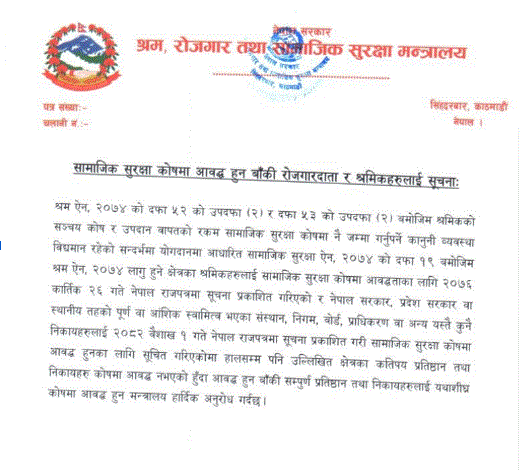
Ministry of Labour, Employment and Social Security Urges Unregistered Employers and Workers to Enrol with the Social Security Fund

Employers and workers who have not yet enrolled with the Social Security Fund (SSF) are urged to do so without delay, as required under the Labour Act, 2074 (2017) and the Contribution-Based Social Security Act, 2074 (2017).

Introduction

The Ministry of Labour, Employment and Social Security, Government of Nepal, has issued a notice urging all employers and workers who have not yet enrolled with the Social Security Fund (SSF) to complete their enrolment at the earliest.

The notice recalls that under Section 52(2) and Section 53(2) of the Labour Act, 2074 (2017), employers are legally required to deposit provident fund and gratuity contributions of workers into the SSF. Pursuant to Section 19 of the Contribution-Based Social Security Act, 2074 (2017), a gazette notification was published on 2076/07/26 (12 November 2019) requiring workers in sectors covered by the Labour Act to enroll with the SSF. 

A further gazette notification was published on 2082/01/01 (14 April 2025) specifically requiring institutions, corporations, boards, authorities, and other similar bodies under full or partial ownership of the Federal Government, Provincial Governments, or Local Governments to enrol with the SSF. Despite these notifications, a number of establishments and bodies in the said sectors have still not completed their enrolment, prompting the Ministry to issue this notice.

Practical Implications

  1. Legal Obligation to Enroll with the SSF

Enrolment with the SSF is not discretionary, it is a statutory requirement under the Labour Act, 2074 (2017) and the Contribution-Based Social Security Act, 2074 (2017). Employers operating in sectors covered by the Labour Act, as well as government-owned or partially government-owned entities, are legally obliged to enroll and make the prescribed contributions on behalf of their workers.

  1. Obligation to Deposit Provident Fund and Gratuity

Employers who have been maintaining separate provident fund or gratuity arrangements outside the SSF must transition these contributions to the SSF in accordance with the applicable legal provisions. Continued non-compliance with this requirement constitutes a breach of the Labour Act, 2074 (2017).

All concerned employers and establishments are strongly advised to complete their SSF enrolment promptly and ensure that ongoing contributions are deposited in accordance with the prescribed timelines and procedures.


Snapshot of Notice

Ministry of Labour, Employment and Social Security Urges Unregistered Employers and Workers to Enrol with the Social Security Fund

This article is for general informational purposes only and does not constitute legal advice, advertisement, personal communication, solicitation or inducement. No attorney-client relationship is created through this content. Gandhi & Associates assumes no liability for any consequences resulting from actions taken based on information contained herein.

For quick legal assistance

Phone/Viber/WhatsApp: +977 9709035477

Government Agencies Issue Joint Notice on Labelling and Quality Regulation of Bottled and Jar Drinking Water

Drinking water bottle and jar manufacturers must comply with new mandatory labelling and packaging requirements, with a 35-day compliance period for bottles and a 60-day compliance period for jars, effective from 2082/12/30 (13 April 2026).

Introduction

The Department of Commerce, Supplies and Consumer Protection (DCSCP), the Department of Food Technology and Quality Control (DFTQC), and the Department of Environment, in coordination with the Nepal Bottle Water Industry Federation and the Nepal Water Industry Federation, have issued a joint notice prescribing mandatory labelling and packaging standards for bottled and jar drinking water sold in Nepal.

The notice has been issued with the objective of ensuring quality standards for drinking water available in the market and reducing environmental pollution.

Key Highlights

Drinking Water Bottles:

  1. The use of additional plastic neck-seals or outer plastic layers over bottle caps is completely prohibited.

  2. In place of neck-seals, manufacturers must mandatorily use embossing, screen printing, or laser printing on bottle caps for producer identification.

  3. Detailed standards will be issued and implemented by the DFTQC.

  4. Manufacturers have been granted 35 days from the date of this notice to fully implement the embossing, screen printing, or laser printing requirement.

Drinking Water Jars:

  1. All drinking water jars must display the following details through embossing or screen labelling in a clearly visible manner: 

  • DFTQC licence number; and

  • Name, address, or logo of the manufacturing company containing all relevant details.

  1. This requirement applies immediately to newly produced jars.

  2. Manufacturers have been granted 60 days from the date of this notice to achieve full compliance.

  3. Joint monitoring and regulation will be conducted by the DCSCP, Department of Environment, and DFTQC.

  4. Technical guidelines will be issued separately by the DFTQC.

Practical Implications

  1. Bottle Manufacturers

Manufacturers must immediately cease the use of plastic neck-seals or outer plastic layers on bottle caps and transition to embossing, screen printing, or laser printing for producer identification within the 35-day compliance period. Detailed technical standards from the DFTQC should be reviewed and implemented upon publication.

  1. Jar Manufacturers

All newly produced jars must immediately carry the DFTQC licence number and manufacturer identification through embossing or screen labelling. Existing production lines must be fully compliant within 60 days. Manufacturers should note that joint inspections by three regulatory bodies will be conducted to verify compliance.

  1. Consequences of Non-Compliance

Products found to be non-compliant during joint monitoring exercises will be subject to regulatory action under prevailing law. Given the involvement of multiple government bodies in enforcement, manufacturers are strongly advised to prioritise timely compliance.

Snapshot of Notice

C:\Users\Gandhi & Associates\Downloads\WhatsApp Image 2026-04-27 at 12.14.46.jpeg

This article is for general informational purposes only and does not constitute legal advice, advertisement, personal communication, solicitation or inducement. No attorney-client relationship is created through this content. Gandhi & Associates assumes no liability for any consequences resulting from actions taken based on information contained herein.

For quick legal assistance

Phone/Viber/WhatsApp: +977 9709035477


Department of Industry Warns Against Use of Information Letters as Substitute for Trademark Registration Certificates

Businesses and trademark applicants are warned that information letters issued prior to 2082/07/28 (14 November 2025) confirming publication in the Industrial Property Bulletin do not constitute trademark registration certificates and must not be used as such, as per the notice issued by the Department of Industry on 2083/01/04 (17 April 2026).

Introduction

The Department of Industry (DOI), under the Ministry of Industry, Commerce and Supplies, Government of Nepal, has issued a notice cautioning all patent, design, and trademark applicants against treating information letters, previously issued to notify applicants of publication in the Industrial Property Bulletin, as temporary or substitute trademark registration certificates.

The DOI notes that the practice of issuing such information letters was discontinued from 2082/07/28 (14 November 2025). Notwithstanding this, the DOI has received reports that certain industries, firms, and companies have been using information letters obtained prior to that date as though they were temporary trademark certificates. The DOI has clarified that this practice is impermissible under Section 18(b) of the Patent, Design and Trademark Act, 2022 (1965), and has warned that legal action will be taken against those found doing so.

Key Highlights

  1. Information letters issued to applicants confirming publication of their applications in the Industrial Property Bulletin were discontinued from 2082/07/28 (14 November 2025).
  2. Such information letters do not constitute, and must not be treated as, temporary or substitute trademark registration certificates.
  3. Under Section 18(b) of the Patent, Design and Trademark Act, 2022 (1965), a trademark may only be used after obtaining a formal trademark registration certificate.
  4. Businesses found using information letters as proof of trademark registration will be subject to action under prevailing law.
  5. Applicants are directed to refer to the DOI’s notice dated 2082/11/17 (01 March 2026) regarding trademark registration and certificate issuance, available at www.doind.gov.np.

Practical Implications

  1. Prohibition on Use of Information Letters as Trademark Certificates

Industries, firms, and companies that received information letters from the DOI prior to 2082/07/28 (14 November 2025) must immediately cease using such letters as evidence of trademark registration or as a basis for trademark use. The law is unambiguous: a trademark may only be used upon obtaining a formal registration certificate from the DOI.

2. Requirement to Obtain Formal Registration Certificate

Applicants whose trademark applications have been examined and published in the Industrial Property Bulletin but who have not yet obtained a formal registration certificate must complete the registration process and obtain their certificate before using the trademark. Use of a trademark without a valid registration certificate constitutes a breach of Section 18(b) of the Patent, Design and Trademark Act, 2022 (1965).

3. Consequences of Non-Compliance

Businesses found to be using information letters as substitute trademark certificates, or using trademarks without a valid registration certificate, will be subject to action under prevailing law. Affected applicants are strongly advised to review the status of their trademark applications and obtain formal registration certificates without delay.

Snapshot of Notice

C:\Users\Gandhi &  Associates\Pictures\Screenshots\Screenshot (71).png

This article is for general informational purposes only and does not constitute legal advice, advertisement, personal communication, solicitation or inducement. No attorney-client relationship is created through this content. Gandhi & Associates assumes no liability for any consequences resulting from actions taken based on information contained herein.

For quick legal assistance

Phone/Viber/WhatsApp: +977 9709035477


Department of Industry Directs Domestic Manufacturers to Label All Products with Maximum Retail Price

All domestic manufacturers must affix Maximum Retail Price (MRP) labels on every product manufactured and sold in Nepal, pursuant to Point 83 of the Government of Nepal’s 100-point governance reform agenda and Section 6 of the Consumer Protection Act, 2075 (2018).

Introduction

The Department of Industry (DOI), under the Ministry of Industry, Commerce and Supplies, has issued a notice directing all domestic industrialists and manufacturers to sell products only after affixing MRP labels, in implementation of the Council of Ministers’ decision of 2082/12/13 (27 March 2026) and Section 6 of the Consumer Protection Act, 2075 (2018).

Point 83 of the 100-point governance reform agenda approved by the Council of Ministers specifically requires mandatory implementation and intensive monitoring of MRP in the market.

Key Highlights

  1. All domestic manufacturers must affix MRP labels on every product manufactured and distributed for sale in Nepal.
  2. Products must not be sold or distributed without an MRP label.
  3. The requirement is grounded in Section 6 of the Consumer Protection Act, 2075 (2018) and the Council of Ministers’ decision of 2082/12/13 (27 March 2026).
  4. Intensive market monitoring will be conducted to enforce compliance.

Practical Implications

Domestic manufacturers must immediately ensure that all products, whether currently in stock or newly manufactured, carry MRP labels before being placed in the market. Non-compliant products identified during market monitoring will be subject to action under the Consumer Protection Act, 2075 (2018) and other prevailing laws.

Snapshot of Notice

C:\Users\Gandhi &  Associates\Downloads\WhatsApp Image 2026-04-27 at 12.14.31.jpeg

This article is for general informational purposes only and does not constitute legal advice, advertisement, personal communication, solicitation or inducement. No attorney-client relationship is created through this content. Gandhi & Associates assumes no liability for any consequences resulting from actions taken based on information contained herein.

For quick legal assistance

Phone/Viber/WhatsApp: +977 9709035477

Department of Commerce, Supplies and Consumer Protection Mandates Maximum Retail Price Labelling on All Imported Goods


Importers must mandatorily display Maximum Retail Price (MRP) on all imported goods sold in Nepal and issue bills/invoices at the point of sale, with a 15-day preparation period granted from 2082/12/30 (13 April 2026).

Introduction

The Department of Commerce, Supplies and Consumer Protection (DCSCP), under the Ministry of Industry, Commerce and Supplies, has issued a press release following discussions held with representatives of the Nepal Overseas Trade Association on 2082/12/30 (13 April 2026), announcing mandatory MRP labelling on all imported goods sold in Nepal.

The measure has been adopted with the objective of strengthening consumer protection and making market management more transparent.

Key Highlights

  1. All importers selling goods in Nepal must mandatorily display the Maximum Retail Price (MRP) on every imported product.
  2. Bills and invoices must be issued at the point of sale for all such goods.
  3. Importers have been granted 15 days from 2082/12/30 (13 April 2026) to prepare and implement MRP labelling on existing stock.
  4. Following the expiry of the preparation period, goods found without MRP during market monitoring will be subject to action under prevailing law.

Practical Implications

Importers must immediately review their existing stock and ensure MRP is displayed on all products before the expiry of the 15-day preparation period. Failure to comply will expose importers to regulatory action during market monitoring exercises. Issuance of bills and invoices at the point of sale is equally mandatory and must be implemented without delay.

Snapshot of Notice

C:\Users\Gandhi & Associates\Downloads\WhatsApp Image 2026-04-27 at 12.13.09.jpeg

This article is for general informational purposes only and does not constitute legal advice, advertisement, personal communication, solicitation or inducement. No attorney-client relationship is created through this content. Gandhi & Associates assumes no liability for any consequences resulting from actions taken based on information contained herein.

For quick legal assistance

Phone/Viber/WhatsApp: +977 9709035477